Friday, January 11, 2013

Tens and Ones

Although many of our students know how to add double-digit numbers using the standard algorithm, sometimes the conceptual understanding behind the math gets lost or forgotten.  To warm up our double-digit addition skills in this unit, we went back to representing numbers using base ten blocks.  In groups of three, students chose the correct pieces to respresent two addends of an addition problem.  When they combined (added) their pieces together, they were able to identify whether they could regroup ten ones blocks as a single tens rod.  The banker helped them make the trade, and students could then identify the final solution to the addition problem.  Keeping this concrete process in mind will allow them to make greater sense of the more abstract process of regrouping ones as tens using the algorithm.
 

Wednesday, January 9, 2013

Adding Tens or Ones

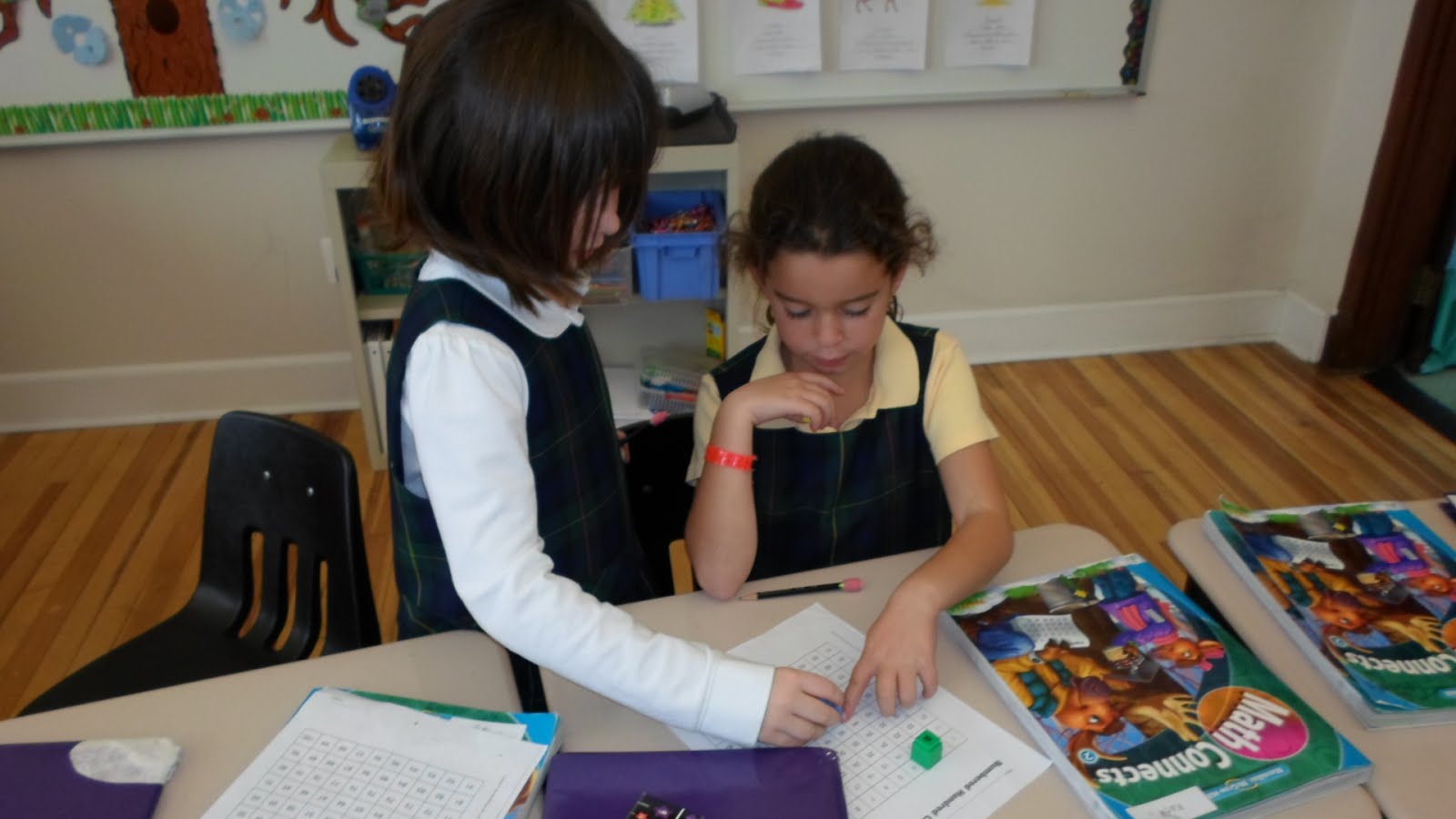
Our enthusiasm and competitive nature were sparked with this game on the hundreds chart.  In pairs, students took turns rolling a die, and decided whether to move that number of ones or tens, with the goal being to land on 99 exactly.  If a student was able to land on the same number as his/her partner, the partner got booted back to square 1! 


Fun with Data

As an introduction to data, surveys, and tally charts, students each created their own survey question with answer choices.  Next, they set up a tally chart to gather data from their peers.  As a class, we did a gallery walk in the hallway and responded to every student's survey question.  Students were then able to use their data to create a pictograph on a folder paper.  Learning is much more meaningful when we can personalize it!
 

Friday, December 7, 2012

Fact Families

Students worked in pairs and used manipulatives to relate addition to subtraction and create fact families.


Sunday, November 11, 2012

Counting On with Literature and Technology

To provide students with a meaningful real-world scenario in which one might use "counting on" as a method of adding, we read the book, 100th Day Worries by Margery Cuyler.  In it, a student is asked to bring one hundred objects to class, in order to celebrate the one-hundredth day of school.  She has trouble thinking of an object of which she can bring in one hundred, but her family helps her realize that she can bring smaller numbers of many different objects.  She keeps adding on, until she reaches one hundred!

 
To provide a strong visual representation of the "counting on" strategy that our main character was using, we used the Splat Square on the SMARTboard.  Students could add on with every new item she found, thus ensuring that she really did make it to one hundred!


iPads in Math Class

As an introduction to our addition chapter, students warmed up their addition facts on the ipads using a variety of apps.


Tuesday, October 9, 2012

Awesome Estimations!

Adults know that estimation is an important lifelong skill.  We use it so often we are likely not even cognizant of the myriad ways estimation saves us time and effort.  The most memorable time estimation played a role in my life was when I won the jelly bean estimating contest at Eddie’s of Roland Park when I was 8 years old (yes, your children are learning from an estimating professional) – but it was certainly not the last time I put my estimating abilities to work!  
 
My guess: 3645.  True total: 3653.  Students: How close was my guess to the actual amount?
Estimating is a skill that takes practice and a trained eye.  In class we looked at Bruce Goldstone’s fantastic photographic book Great Estimations.  In it, Mr. Goldstone models the skill of “clump counting.”  The idea is that if you can recognize a clump of ten, then you can estimate a much larger amount by assessing how many clumps of tens there are in total. 


Using our digital camera and classroom supplies, students worked in pairs to photograph their own pages of our class estimation book.  First, students counted out ten of their object and took a picture.  Then, after adding a handful or two (or three, or four!) more, students photographed a much larger collection of their item.  After estimating how many groups of tens there were altogether, students were allowed to count the exact amount.  The final product is our very own guess-and-check estimation book. 
 

 Go ahead and put your estimating skills to the test!
(answers found at the bottom)


؛212 :sʞɔɐʇqɯnɥʇ ؛30 :sɹossıɔs ؛50 :sɹǝsɐɹǝ ؛37 :sןıɔuǝd pǝɹoןoɔ ؛127 :sǝqnɔ ƃuıʇɔǝuuoɔ ؛44 :suoʎɐɹɔ